
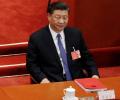
Chinese President Xi Jinping is all set for an unprecedented third five-year term as he was 'elected' to the powerful Central Committee of the ruling Communist Party on Saturday while several top leaders including Premier Li Keqiang have been left out in the major shake-up at the top.

'A participant in many rounds of the border talks with China once told me that China seemed not interested in resolving the border issue as it wanted to keep it as a ready excuse to intervene in the sub-continent,' says Colonel (retd) Anil A Athale.

With Pakistan in mind, Prime Minister Manmohan Singh on Thursday warned that terrorism and radicalism emanating from "our neighbourhood" had directly affected both India and China and could lead to instability across Asia.
Observers say China should re-address its policies towards India or else it will continue to face flare-ups increasing the tensions between the two countries at a time China's increasing tension with the US over Taiwan and the South China Sea besides the downturn in the Chinese economy which is hit hard by the zero-covid policy.
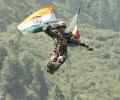
So far, the Central Sector has never seen active hostilities, remaining peaceful even through the 1962 war. A reason for the Central Sector having remained peaceful is the towering Himalayan watershed that defines the border.

Indian Army officers are convinced China is maintaining the pretence of dialogue and negotiations in order to create the opportunity to occupy more Indian territory. Senior Indian planners apprehend this might be a Chinese ploy to divert attention from Depsang, in Northern Ladakh, which might be China's actual target.

'The military advantage the Indian Army had gained by the Special Frontier Force occupying the heights of the Rezang La-Rechin La ridge on the Kailash Range is lost without the PLA withdrawing to east of the Khurnak Fort line.'

'For the common man, the economic conditions are not going to get better.'

This is the first time such a bilateral dialogue focusing on Central Asia where the two countries have long and historical ties was held, reflecting deepening diplomatic engagement between the two neighbours even as they try to sort out friction resulting from recent reported incursions by Chinese troops along the Ladakh border

'Neither will China -- at least for now -- because its troops are deployed in equal strength.' 'We are negotiating at equal terms right now and it's a game of patience.'

'When you look at the border -- from Ladakh to Arunachal -- which is called the Sino-Indian border, but in effect it is actually the Indo-Tibet border.' 'Since the borders are still not secure, it has resulted in transgressions in Galwan, Dokalam etc.'

'How and if India retaliates will go a long way toward determining the trajectory of this crisis.'
China will always try to set the agenda for negotiations and tries through such means to determine the direction of talks, and to avoid discussing subjects that may paint it into a corner or compel the Chinese negotiator to disclose their position prematurely.

This is the first time Pakistan and Kashmir have been brought into the narrative.
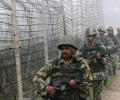
Most of India's reserves for war in the mountains have been sucked in by the standoff with China. A large part of India's airpower has also similarly been committed on the eastern border. By moving these reserves to the China border, India has been weakened vis-a-vis Pakistan. All in all, the nightmare scenario for India of a two-front war may well come true, warns Colonel Anil A Athale (retd).

Referring to allegations that it was "silly for China" not to have names for various counties and inventing them for six places in Arunachal Pradesh, an op-ed article in the state-run Global Times said "these comments are absurd".

'The Fire and Fury Corps is the only formation of the Indian Army and also in the world to have actually deployed mechanised forces in such harsh terrain. The maintenance of the tanks, infantry combat vehicles and heavy guns is a challenge in this terrain. To ensure crew and equipment readiness, adequate arrangements are in place for both man and machine'
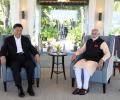
'China physically occupies about 45,000 sq km of J&K as claimed by India, including 3,000 sq km captured in the 1962 War and never returned; and 5,180 sq km ceded to China by Pakistan in 1963.' 'It is hard to justify remaining silent about the return of China occupied Ladakh,' observes Ajay Shukla.
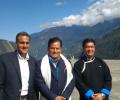
China claims Arunachal Pradesh as part of southern Tibet and routinely protests visits by Indian leaders, foreign officials as well as the Dalai Lama to the area.

India and China met and spoke a lot this year, but failed to produce any meaningful results.

The papers said India is using the Dalai Lama as a "diplomatic tool" against China for its "vice like veto" against India's membership in the Nuclear Suppliers Group and United Nations ban on Jaish-e-Mohammed chief Masood Azhar.

While Prakriti's father has retired from the Indian Air Force, Deeksha's father Kamlesh Kumar is an Inspector in the ITBP.
'We are fully capable of handling anti-India propaganda but it does pain when a former president of such a big political party does ochi rajiniti (shallow minded politics) at a time of problems. It is a matter of self-introspection for him and the Congress'
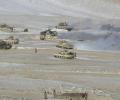
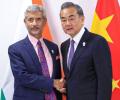
During their hour-long in-person meeting on the sidelines of a Shanghai Cooperation Organisation (SCO) conclave in Dushanbe on Wednesday, External Affairs Minister S Jaishankar also told his Chinese counterpart and State Councilor Wang Yi that any unilateral change in the status quo along the Line of Actual Control (LAC) was 'not acceptable' to India and that the overall ties can only develop after full restoration of peace and tranquillity in eastern Ladakh.

Through the past 18-month period, peace has prevailed in the disputed border regions, which was immensely helpful in the difficult situation that the country was passing through, observes Ambassador M K Bhadrakumar.

The Chinese have only created limited defences for protection of their posts which are located well in depth and much away from the Line of Actual Control, notes Colonel S Dinny (retd).
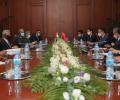
In a meeting on the sidelines of the summit of the Shanghai Cooperation Organisation (SCO) in Dushanbe on Thursday, the two foreign ministers exchanged views on the current situation in the region and agreed that military and diplomatic officials of both sides should meet again and discuss resolving the remaining issues at the earliest.
'With Punjab and Kashmir in flames, it would not have been politically wise to alienate the West.' 'It would have inclined Western countries towards Pakistan.' 'It would have been a self-goal.'

'Given the way in which the PLA operates today, I don't believe local commanders were necessarily acting without approval of higher levels.' 'They were acting in a way which they believed they were carrying out the intent of the higher levels.'

The prime minister and the Chinese president walked along the banks of East Lake and also took a boat ride together as they decided to step up their personal rapport.

The MEA spokesperson further said the actions and behaviour of the Chinese side since earlier this year along the LAC have been in "clear violation" of the bilateral agreements and protocols concluded between the two countries to ensure peace and tranquility on the border.

'It will be a repeated folly to ever think that China will not attack us.'
The international community must be clear that such a behaviour is unacceptable, a top US senator said.
He said that following a build-up of troops, multiple transgressions and attempts to unilaterally change facts on the ground by China, there have been several levels of talks and a fair amount of communication to ensure that the matter can be resolved through negotiation and diplomacy.
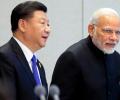
The Ministry of External Affairs (MEA) on Friday said Modi will lead the Indian delegation at the summit. "The prime minister will lead the Indian delegation to the 20th summit of the SCO council of heads of state which will be held in the virtual format on Nov 10. The meeting will be chaired by Russian President Vladimir Putin," MEA Spokesperson Anurag Srivastava said.
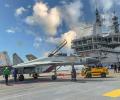
New Delhi's regional partners in restraining a belligerent China -- primarily the US, Japan, Australia and Singapore -- would like the Indian Navy to lock down the Indian Ocean Region, while the other partners can focus on deterring the PLA (navy) in the South China Sea, explains Ajai Shukla.
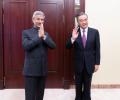
'We stress that the boundary issue shall not be linked with the overall bilateral relations. That is an important experience we have gathered through many years' effort to keep the ties moving forward
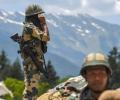
Gen Naravane said India is dealing with China in a "firm" and "non-escalatory" manner to ensure the sanctity of its claims in eastern Ladakh, and that it was even open to initiating confidence-building measures.

The Chinese aren't after territory. Their target is our national will, morale and the sense of autonomy we feel in making our strategic choices. They are attacking India and the Modi government at their weakest point, asserts Shekhar Gupta.
